

2 december 2025
Glacial flour and bacteria
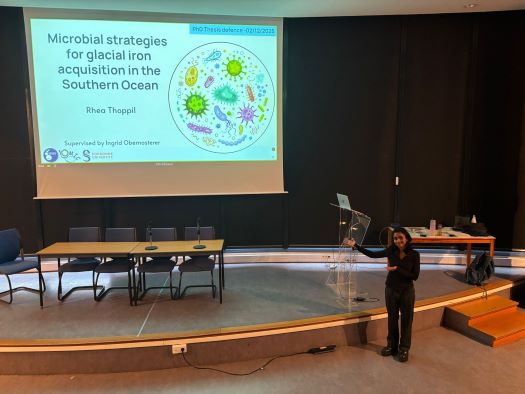
After 3 years of work in the projects BINGO, MARGO and SIDEMAR; Rhea Thoppil has presented her PhD work entiteled "Microbial strategies of glacial iron acquisition in the Southern Ocean" . the members of the jury were Sara Beier (rapporteure), Scarlett Trimborn (rapporteure), Sophie Novilos (examinatrice), Fabien Joux (president) et Ingrid Obernosterer (directrice de thèse).
Summary
The micronutrient iron (Fe) constrains microbial activity and growth across large regions of the Southern Ocean (SO). The supply of Fe and its bioavailability have therefore profound effects on the structure and functioning of microbial communities. Among the external sources that have been identified thus far, Fe contained in meltwater originating from glacial erosion has rarely been considered. This thesis explores the strategies that SO microbes use to acquire glacial Fe focusing on the colloidal fraction (20–200 nm) present in meltwater of the Cook Ice Cap on Kerguelen Island. A main objective of this thesis is to study the role of siderophores, organic compounds that strongly bind Fe thereby rendering it bioavailable. Siderophores are produced by certain prokaryotic taxa, and they can be utilized by diverse microbes. Siderophores therefore play a key role in the redistribution of Fe across microbial communities.
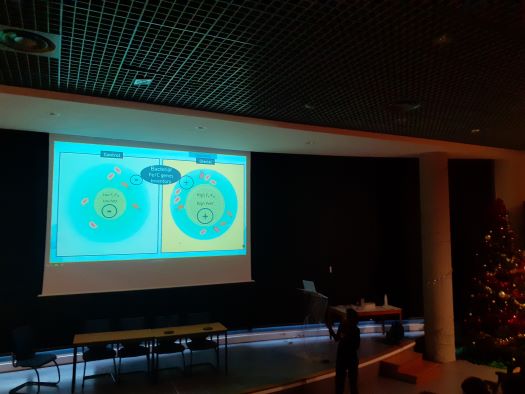
Chapter 1 investigates the mechanisms of marine prokaryotes to access colloidal Fe of glacial origin. Through incubation experiments with SO prokaryotic communities, the microbial responses to glacial versus non-glacial colloids were compared, using bulk parameters, amplicon sequencing and metagenomics. The results were striking: glacial colloids triggered a clear restructuring of prokaryotic communities that were enriched for genes involved in the biosynthesis and transport of the siderophores pyoverdine and vibrioferrin. Genes for the transport of both siderophores were present in diverse metagenome-assembled genomes (MAGs), while biosynthesis genes were detected in fewer ones. These results suggest that the utilization of siderophores facilitates the access to Fe from glacial colloids and point to the key role of specific prokaryotes rendering this source of Fe available to SO microbial communities.
Building on this, Chapter 2 explores whether prokaryotic strategies might also benefit phytoplankton. Therefore, the response of the entire microbial community was followed during on-board incubation experiments carried out in the SO. A combined approach of absolute and relative abundances of Fe and organic carbon related genes and transcripts was used to capture the response of prokaryotes and phytoplankton. The results suggest that prokaryotic access to glacial colloidal Fe through the production of siderophores may indeed spill over to phytoplankton, hinting at subtle but significant mutualisms that could boost productivity in Felimited waters. Through the identification of MAGs that harbored and expressed the genes of interest, the findings provide insights into the potential role of distinct prokaryotic taxa in rendering glacial Fe bioavailable thereby shaping microbial dynamics and carbon cycling in the SO.
Chapter 3 turns the lens to a specific siderophore that is petrobactin. Experiments carried out with the bacterial strain Marinobacter nauticus and gene knockout mutants allowed to identify two specific transporters (optA and optB) for petrobactin in this model organism. The presence of these transporters was examined in resuscitated prokaryotic communities from the SO, grown in incubations amended with Fe-petrobactin. Metagenomic analyses revealed high abundances of pirA siderophore transporters. Two Pseudoalteromonas-affiliated MAGs contained pirA sequences with high amino acid identity to optB and these MAGs showed higher coverage in the Fe-petrobactin amended treatments as compared to the control. Phylogenetic analysis highlighted two evolutionary strategies whereby optA-like transporters co-evolved with petrobactin biosynthetic clusters, while optB-like transporters evolved independently, enabling xenosiderophore exploitation.
Together, the three chapters of this thesis uncover the hidden strategies SO microbes use to solve the iron limitation conundrum and for predicting how the SO will continue to shape global nutrient cycles and the warming ocean.